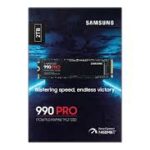
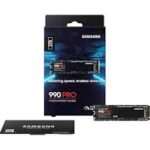
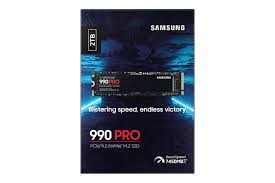
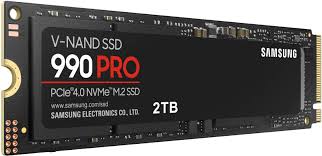
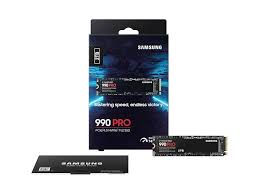
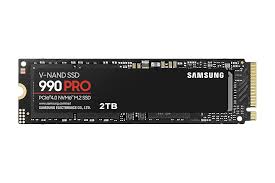
Description
🔧 Specifications & Capabilities
| Specification | Detail |
|---|---|
| Form Factor | M.2 2280 (80 × 22 × 2.3 mm) |
| Interface | PCIe 4.0 ×4, NVME 2.0 |
| NAND Type | Samsung V-NAND TLC (3-bit per cell) with in-house controller |
| DRAM Cache | 2 GB LPDDR4 |
| Sequential Read Speed | Up to 7,450 MB/s |
| Sequential Write Speed | Up to 6,900 MB/s |
| Random Performance (QD32 / 4 KB) – Read | 1,400,000 IOPS |
| Random Performance (QD32 / 4 KB) – Write | 1,550,000 IOPS |
| Power Consumption (Read/Write Active) | 5 – 6 W range (writes/read) with peaks in burst situations |
| Idle Power | 55 MW |
| Operating Temp Range | 0 °C to 70 °C |
| Endurance / Warranty | 5 years or 1,200 TBW (Terabytes Written) for the 2 TB model |
✅ What’s Great About It
-
Top-tier performance: These sequential read/write speeds are near the theoretical limits of PCIe 4.0 ×4. If your motherboard supports that, you’ll get blazing fast transfers for large files, games, edits, etc.
-
High IOPS: Makes a big difference for tasks with many small random reads/writes — think operating system workloads, application launches, etc.
-
Strong endurance: 1,200 TBW → that’s solid reliability for the typical life span of a consumer SSD (5 years warranty).
- Efficient design: Despite being powerful, it’s designed to stay cooler with a heat spreader label + thermal control; reasonable idle consumption helps save energy when idle.
-
Backward compatibility: Works in PCIe 3.0 slots (just won’t reach full speed)
⚠️ Things to Watch Out For
-
Heat under heavy load: At full write/rate/sustained loads, it will generate heat. Proper PC airflow or use of a heat sink helps maintain performance.
-
Cost: Premium speeds and specs come with a premium price tag. If your workload doesn’t need max throughput, there may be cheaper alternatives.
-
Diminishing returns: If your tasks are mostly light (web, office, casual gaming), you likely won’t notice much difference between this and mid-range PCIe4 SSDs.
-
Physical space for cooling: Some laptops or small form-factors may struggle with adequate cooling for these high speeds.
🔍 Good Use Cases vs Overkill Situations
| Ideal For | Maybe Overkill If |
|---|---|
| • Gamers or video editors transferring very large files or doing 4K/8K editing. • Power users, developers, or creators who need ultra-fast compile/build/asset load times. • Anyone looking for long lifespan with a high endurance drive. |
• Users whose usage is just documents, streaming, light software. • Older systems limited to PCIe 3.0 (you can’t get full benefit). • Budget builds where money might be better spent elsewhere. |
🔎 Final Thoughts
The Samsung 990 PRO 2 TB (MZ-V9P2T0BW) is among the best NVME SSDs you can buy today for high-performance PC use. If your system can support its speed (PCIe 4.0 ×4) and you need the bandwidth or frequent large file transfers, you’ll get your money’s worth. Otherwise, a slightly slower but cheaper SSD might give you similar day-to-day responsiveness.




Reviews
There are no reviews yet.